
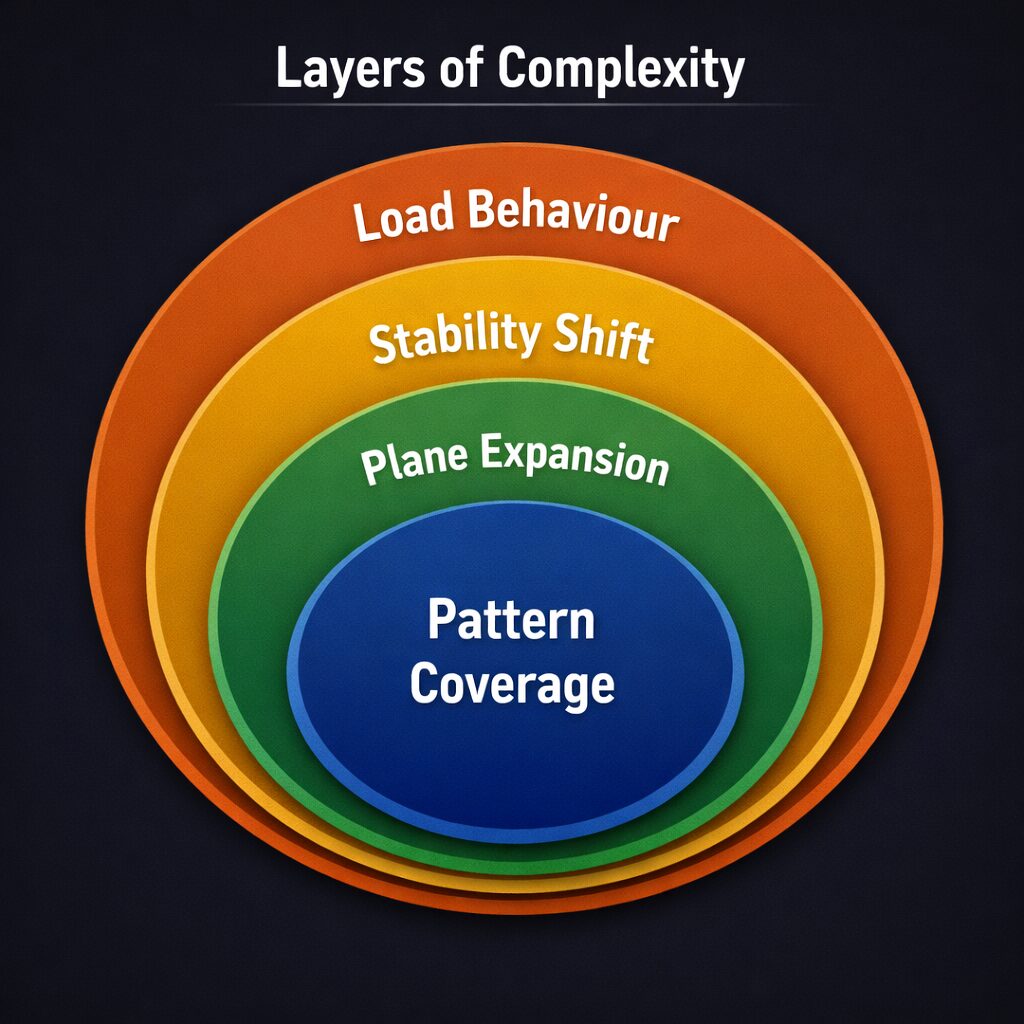
Theme: Complexity increases stress demand. It must follow capacity — not time.
🎯 Teaching Objective
By the end of this lesson, the coach should:
- Understand what complexity means inside the 3D Strength System
- Be able to layer stress without rigid phases
- Know when to progress — and when not to
- See how complexity interacts with the Durability Triangle
This is not a progression ladder.
It is a stress-layering lens.
PART 1 — What Complexity Actually Means
Complexity is not:
Advanced exercises.
Fancy movements.
Instability for its own sake.
Complexity means:
Increasing coordination demand.
Increasing asymmetry exposure.
Increasing multi-plane integration.
Increasing load unpredictability.
In other words:
Increasing how much the body must organize force.
Complexity increases control demand first.
Then range demand.
Then force demand.
That’s why it must follow capacity.
PART 2 — The Four Layers
These layers describe how stress exposure can increase.
They are not stages.
They are variables.
Layer 1 — Pattern Coverage
Are all primal patterns present?
• Hinge
• Squat
• Lunge
• Push
• Pull
• Rotation
• Gait / single-leg stability
This ensures foundational literacy.
Without full pattern coverage, durability cannot be complete.
This supports Range + Force pillars.
Layer 2 — Plane Expansion
Are patterns trained beyond sagittal?
Add:
• Frontal plane
• Transverse plane
• Rotational integration
This expands usable range and rotational capacity.
This primarily feeds the Range pillar.
Most programs stop at Layer 1.
That’s the linear trap.
Layer 3 — Stability Shift
Shift from:
Bilateral → Unilateral
Symmetrical → Asymmetrical
Introduce:
• Single-arm loading
• Split stance
• Anti-rotation
• Offset leverage
This increases Control demand significantly.
Asymmetry exposes weakness.
Layer 4 — Load Behaviour Selection
Now manipulate stress behaviour.
Introduce:
• Fixed load
• Live load
• Offset load
• Momentum load
• Reactive base
This shifts which pillar is under pressure.
The Matrix amplifies demand.
PART 3 — The Critical Rule
This is not:
Layer 1 → Layer 2 → Layer 3 → Layer 4 → Forever.
It is:
Capacity-driven exposure.
You only increase complexity if:
Range holds.
Control holds.
Structure holds.
If quality collapses, regress the layer — not the entire system.
Complexity must follow structural integrity.
PART 4 — How It Connects to the Decision Model
The Decision Model identifies:
Which pillar is weak.
Layers of Complexity determine:
How much stress exposure is appropriate.
For example:
If Control is weak →
Increase asymmetry before increasing momentum.
If Range is weak →
Expand planes before increasing load behaviour complexity.
If Force is weak →
Stay lower in complexity and increase stable output.
This is how the layers protect durability.
PART 5 — What This Prevents
Without layered complexity, coaches:
• Add instability too early
• Add speed without control
• Add rotation without range
• Add asymmetry without strength
That creates fragility.
Layered complexity prevents overexposure.
PART 6 — Closing Line
Progression is not adding chaos.
Progression is increasing complexity only when structure allows.
Durability grows when complexity is earned — not imposed.
This now:
- Aligns with the Decision Model
- Protects against rigidity
- Reinforces capacity-first thinking
- Feels engineered
- Doesn’t contradict earlier architecture